Windelo 50
Overview
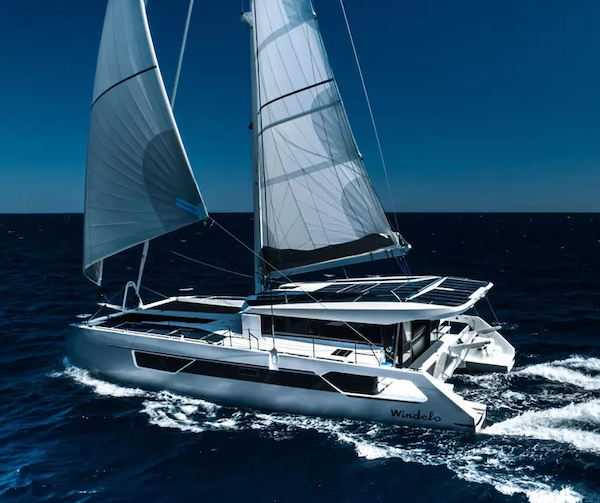
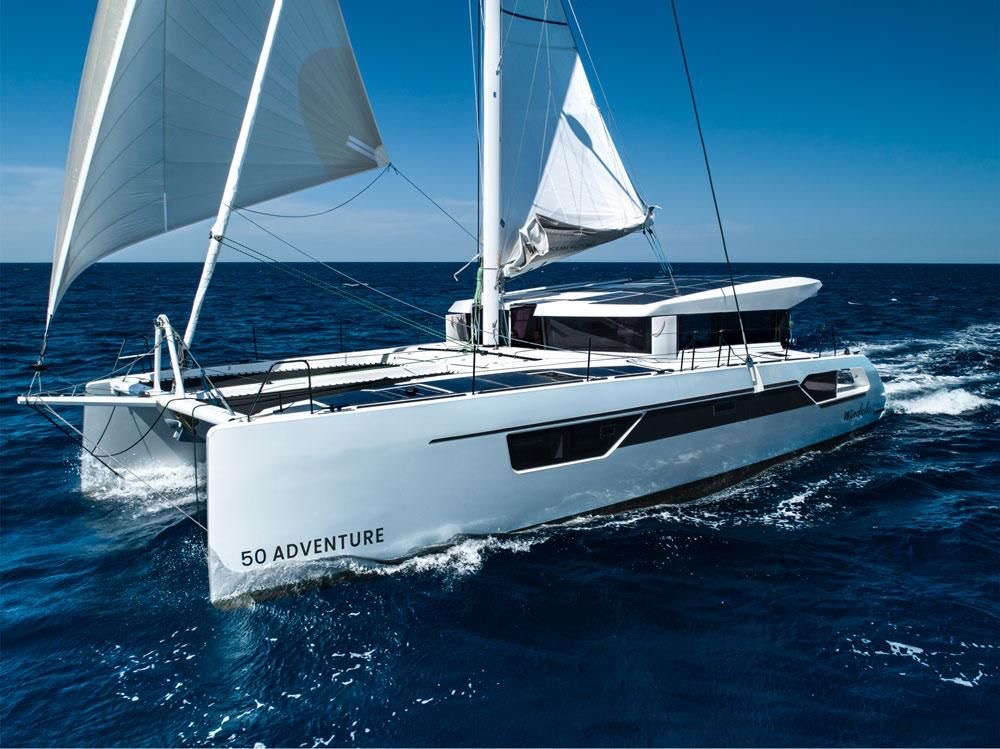
The Windelo 50 is a 50-foot performance cruising catamaran built by the French shipyard Windelo Catamarans, based in Canet-en-Roussillon in southern France. Introduced in 2021 and designed by the Barreau/Neuman architectural duo, it is aimed squarely at bluewater cruisers who want genuine offshore capability alongside a low environmental footprint. Three versions are offered — Adventure, Yachting, and Sport — covering a range from rugged offshore passage-making to charter-ready comfort. The design was refreshed in mid-2023 with a sleeker profile and an expanded hardtop that accommodates a larger solar array.
The boat's defining characteristic is its commitment to electric propulsion combined with renewable energy harvesting. Twin 20 kW Beta Marine 48V shaft-drive electric motors handle propulsion, backed by a 17.9 kW diesel generator that acts as a range extender. A 1,120 Ah lithium battery bank is charged by up to 6,000 watts of solar panels, MaxProp hydrogeneration propellers, and an optional wind turbine — making extended passages under electric power genuinely practical.
Design and Construction
Windelo differentiates itself through its choice of hull materials. Rather than conventional fiberglass, the hulls and deck use a sandwich construction with volcanic basalt fiber woven rovings in place of standard glass reinforcement, combined with recycled PET foam core rather than balsa wood. Basalt fiber offers good stiffness and tensile strength while being sourced from a naturally occurring mineral, and PET foam is fully recyclable at end of life. The result is a structure that Windelo claims is both lighter and more environmentally benign than a conventional fiberglass catamaran of similar size.
The underwater appendages are daggerboards rather than fixed keels, allowing the boards to be raised fully (minimum draft around 3' 5") for shallow-water access or lowered to improve upwind performance. The rig is a sloop with a self-tacking jib, and the running rigging leads aft to a central cockpit console equipped with winches and line organizers. Twin helms are positioned close together within an enclosed cockpit that shares the same level as the main saloon.
Under Sail
In test conditions of 15 knots of true wind with a short chop, the Windelo 50 recorded around 9 knots at 60 degrees apparent wind angle and settled at 6.2 knots when pinched to 40 degrees with the self-tacking jib. Bearing away to 110 degrees apparent in 17 knots of breeze with a Code 0 produced speeds of 10 knots, confirming the boat rewards off-wind sailing. The slender, well-balanced hulls contribute to these numbers; Windelo reports an upwind sail area of 1,453 square feet and a downwind area of 2,723 square feet with the gennaker set.
The MaxProp feathering propellers double as hydrogeneration units at speeds above 9 knots, feeding power back into the battery bank while sailing. This regenerative capability, combined with the solar panels, means careful crews can cover significant ocean miles without running the diesel generator at all.
Specifications
| LOA | 50' 1" (15.24 m) |
|---|---|
| Beam | 26' 0" (7.95 m) |
| Draft (max) | 7' 7" (2.32 m) |
| Draft (min, boards up) | 3' 5" (1.03 m) |
| Displacement (light) | 24,691 lbs (11.20 t) |
| Sail Area (upwind) | 1,453 sq ft (135 m²) |
| Mainsail | 990 sq ft (92 m²) |
| Foresail | 463 sq ft (43 m²) |
| Engine | Twin 20 kW Beta Marine 48V electric motors + 17.9 kW diesel generator |
| Fuel | 145 gal (500 L) |
| Water | 106 gal (400 L) |
| Designer | Christophe Barreau & Frédéric Neuman (Barreau/Neuman) |
| Builder | Windelo Catamarans (Canet-en-Roussillon, France) |
| Year | 2021 |
| Rig | Sloop |
Accommodation
The Windelo 50 is available in configurations carrying up to four guest cabins plus a dedicated skipper's berth. In the Yachting layout, the port hull contains a full-width owner's suite with an athwartship double bed, private head, and a small writing desk. The starboard hull houses two additional cabins — a narrower forward double and a larger aft double — sharing a second head. A fifth berth in a separate forward compartment is intended for a paid crew or skipper.
The saloon sits on the same level as the working cockpit, blurring the boundary between inside and outside living in a way that suits tropical cruising. Large windows and a wraparound coach roof bring abundant light into the main cabin. The galley is positioned between the cockpit and the saloon table, keeping the cook close to the action on deck. Storage throughout is generous, and the hulls carry dedicated space for the battery bank and electrical infrastructure.
Links, References and Further Reading
Image Gallery