Swan 54
Overview
The Swan 54 is a Finnish bluewater cruising yacht designed by Germán Frers for Nautor Swan and introduced in 2015, with first customer deliveries in 2016. Conceived as a second generation of dedicated offshore cruisers from the storied Finnish yard, the 54 was positioned as the largest yacht a couple could comfortably manage shorthanded over long passages. Interior design was handled by Heini Gustafsson, who specified natural oak throughout.
Two keel configurations are offered: a standard deep fin keel drawing 2.44 m, and an optional variable-draught daggerboard system paired with twin rudders that adjusts between 1.40 m and 3.70 m — a significant advantage for shoal-water cruising. At about €1.1 million ex-VAT, the Swan 54 competes at the upper end of the bluewater production market.
Design and Construction
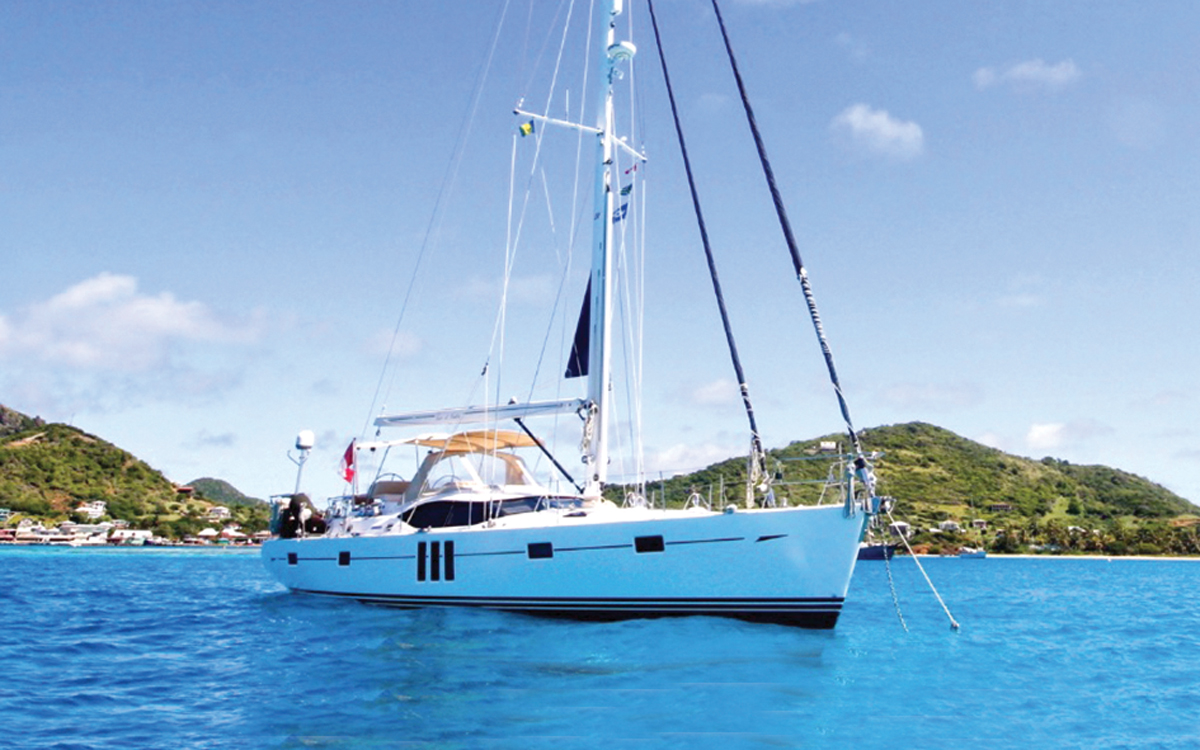
Frers gave the Swan 54 a moderate, purposeful hull shape — a deep-V underbody, a raked bow, and a sloping transom that folds down to form a 2.5-metre bathing platform. These are traditional ocean-going attributes rather than racing-oriented shortcuts, prioritising a comfortable motion in a seaway over absolute upwind performance. The hull is constructed in single-skin glassfibre reinforced with a vinylester laminate, a deliberate step away from the lightweight carbon lay-ups found on contemporary Swan performance models and towards durability and ease of maintenance.
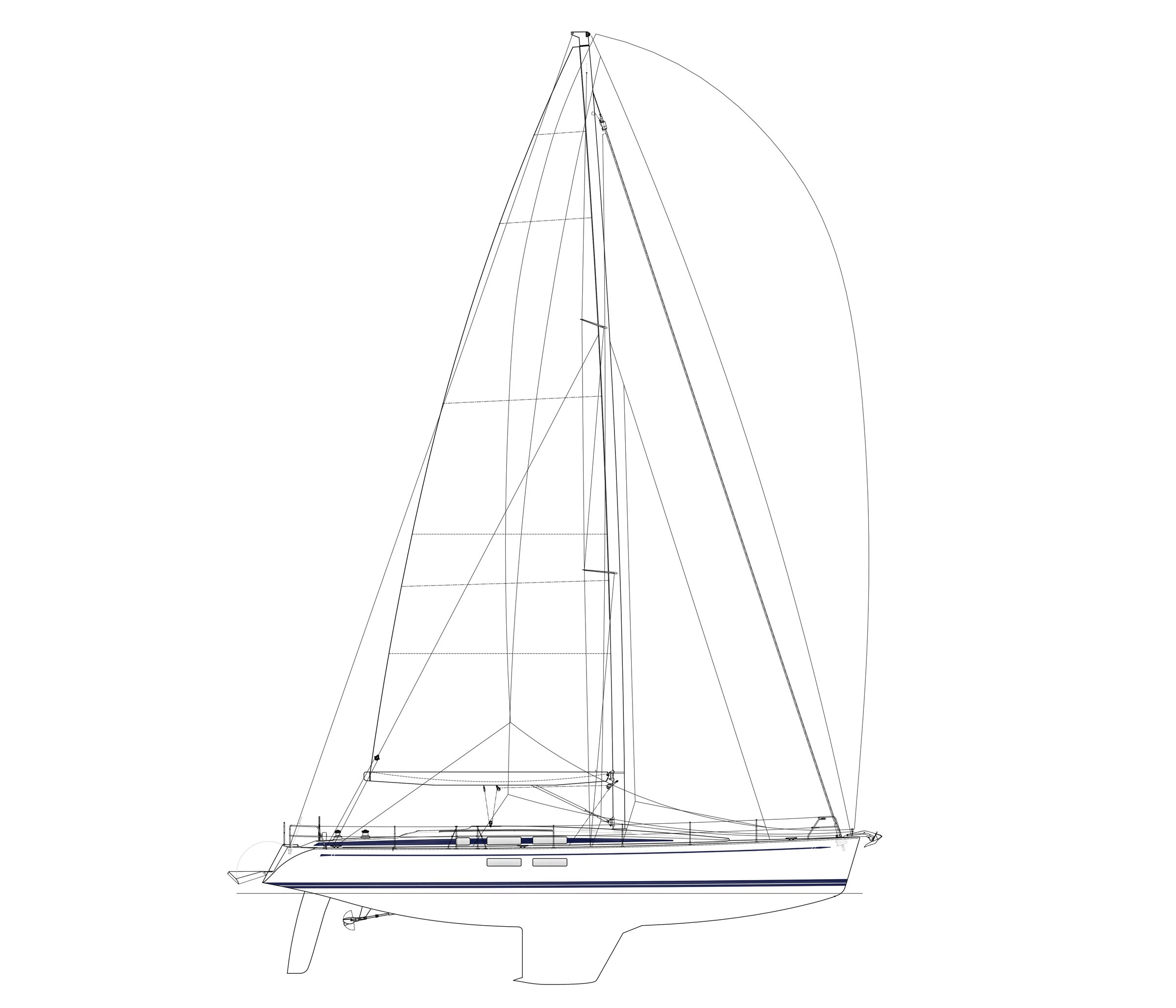
The rig is a fractional sloop with the hinge point at the 15/16 position, keeping the genoa manageable for short-handed sailing. The mainsheet and jib tracks are led to the coachroof rather than the side decks, leaving the cockpit clear and allowing a bimini to be fitted. Four powered winches service the coaming positions near the twin helms.
Under Sail
With a light displacement of 22,000 kg and a prismatic coefficient tuned for average speeds above 8 knots, the Swan 54 is capable of brisk passages without sacrificing the sea-kindly motion expected of a long-distance cruiser. The high-performance lead keel in the standard configuration provides stiff initial stability, while the deep-V hull sections keep the vessel tracking smoothly in steep head seas.
The optional daggerboard and twin-rudder package adds versatility in light air and shallow anchorages, at the cost of some mechanical complexity. The 110 hp Yanmar engine with folding propeller handles motoring duties efficiently, and a 600-litre fuel tank provides good range under power for passages through the doldrums or along congested coasts.
Specifications
| LOA (hull) | 54' 1" (16.48 m) |
|---|---|
| LOA (incl. bow fitting) | 55' 9" (17.00 m) |
| LWL | 47' 3" (14.40 m) |
| Beam | 15' 7" (4.75 m) |
| Draft (standard fin keel) | 8' 0" (2.44 m) |
| Draft (daggerboard, raised/lowered) | 4' 7" – 12' 2" (1.40 – 3.70 m) |
| Displacement (light) | 48,500 lb (22,000 kg) |
| Displacement (loaded) | 57,300 lb (26,000 kg) |
| Ballast (standard keel) | 18,100 lb (8,200 kg) |
| Ballast (daggerboard option) | 22,400 lb (10,150 kg) |
| Sail Area (mainsail) | 873 sq ft (81.1 m²) |
| Sail Area (100% jib) | 665 sq ft (61.8 m²) |
| Spinnaker | 2,260 sq ft (210 m²) |
| Engine | Yanmar 110 hp (81 kW), folding propeller |
| Fuel Capacity | 158 USg (600 L) |
| Water Capacity | 193 USg (730 L) |
| Designer | Germán Frers |
| Interior Designer | Heini Gustafsson |
| Builder | Nautor Swan (Finland) |
| Year | 2015 (first customer delivery 2016) |
| Rig | Sloop |
| Keel | Fin keel |
Accommodation
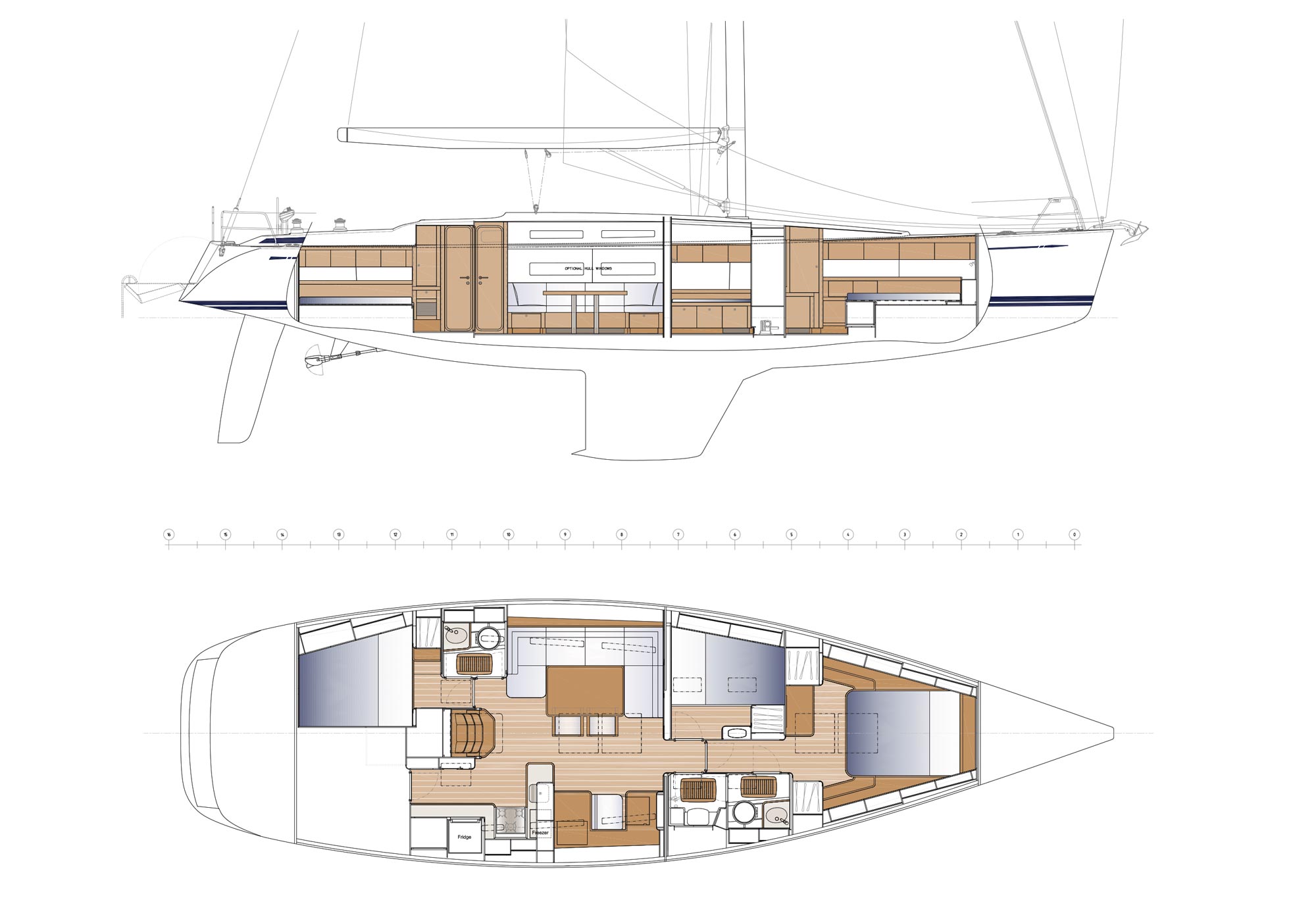
Below decks the Swan 54 is arranged around a central 3-metre C-shaped saloon with a fixed dining table. The standard layout offers three double cabins — an owner's stateroom forward with two heads, two guest cabins amidships — plus a dedicated utility space aft that can be fitted out as a workshop, laundry room, generator room, or a crew berth. An alternative layout stretches to four cabins, while a two-cabin variant adds a large private office for owners who work at sea.
The galley runs approximately 3 metres and can be specified with up to three refrigerators, reflecting the boat's passage-making pedigree. Water capacity is 730 litres, with a 50-litre hot-water calorifier and 120-litre holding tanks rounding out the live-aboard infrastructure. The 24V electrical system centres on a 525 Ah gel-cell service bank.
Links, References and Further Reading
Image Gallery