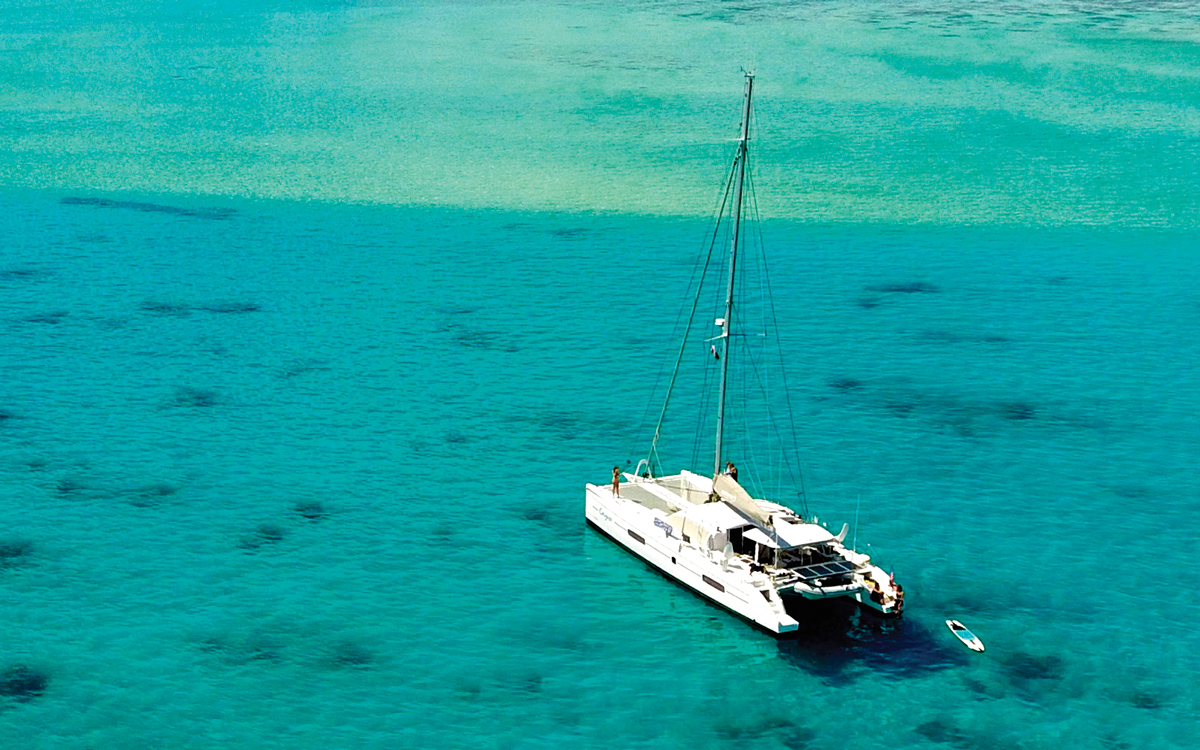
Outremer 51
Overview
The Outremer 51 is a fast bluewater cruising catamaran built by Outremer Yachting in France and designed by the naval architecture team of Christophe Barreau and Frédéric Neuman. First delivered in 2013, it quickly became the yard's best-selling model and earned European Yacht of the Year and US Boat of the Year recognition. With a light-ship displacement of around 11 tonnes and the capacity to carry an additional three tonnes of cruising gear and equipment, the 51 was conceived around the principle that a lighter, faster boat is ultimately more capable and more enjoyable offshore.
The 51 evolved from Outremer's earlier 49-foot model following a comprehensive survey of existing owners, which drove lengthening of the hulls and a series of refinements to deck layout and systems. By the late 2010s, well over 100 examples had accumulated hundreds of thousands of ocean miles, with owners completing circumnavigations and extended passages across all major ocean basins.
Design and Construction
The Outremer 51's hull and deck are built using a PVC-foam-core sandwich laminate with E-glass and epoxy resin, with solid laminate applied below the waterline and under deck hardware. Resin infusion is used throughout the process to minimize weight and voids. Carbon fiber is employed in load-bearing structural elements such as bulkheads, keeping displacement low without sacrificing structural integrity. Progressive refinement of the build process allowed the yard to reduce weight by roughly 600 kg compared to earlier iterations of the design.
Spars are aluminum as standard, though a carbon rotating wing-mast is a popular option that further improves performance in light air. Daggerboards provide lateral resistance and can be raised to reduce draft to under one metre for shallow-water anchoring. The cockpit features a rigid bimini and is designed for offshore watch-keeping, with good visibility from the chart table and controls configured for short-handed sailing.
Under Sail
In 10–15 knots of breeze the Outremer 51 will comfortably reach 10 knots under mainsail alone, with a screecher or gennaker lifting that figure further. Owners report peak speeds of around 20 knots in stronger conditions, while long-passage averages of 7.5 knots are typical. The sail-area-to-displacement ratio of roughly 27 reflects the boat's performance orientation, and the relatively narrow, fine-entry hulls reduce drag at passage-making speeds. Optional tiller steering, unusual on a cruising catamaran of this size, is retained for its directness of feel and is praised by experienced sailors.
The generous freeboard and hull volume contribute to a reassuring motion in a confused seaway, and the layout of winches and lines makes the boat genuinely manageable by a crew of two. The daggerboard configuration allows the crew to balance the boat efficiently across a range of points of sail.
Specifications
| LOA | 51' 4" (15.65 m) |
|---|---|
| Beam | 24' 5" (7.45 m) |
| Draft (boards up) | 3' 1" (0.95 m) |
| Draft (boards down) | 7' 8" (2.35 m) |
| Displacement (light) | 24,251 lbs (11,000 kg) |
| Displacement (max) | 30,203 lbs (13,700 kg) |
| Sail Area (upwind) | 1,389 ft² (129 m²) |
| Sail Area (downwind) | 2,734 ft² (254 m²) |
| Mainsail | 958 ft² (89 m²) |
| Engine | 2 × 40 HP Volvo diesel (inboard saildrive) |
| Fuel | 88 gal (333 L) |
| Water | 100 gal (379 L) |
| Cabins | 3–4 |
| Berths | 6–11 |
| Heads | 3 |
| Designer | Christophe Barreau & Frédéric Neuman |
| Builder | Outremer Yachting (France) |
| Year Introduced | 2013 |
| Rig | Sloop |
Accommodation
The Outremer 51 is available in three- or four-cabin arrangements, with berths for between six and eleven people depending on configuration. In the three-cabin layout the port hull is dedicated to a full-width owner's stateroom with its own en-suite head and shower, while the starboard hull houses two guest or crew cabins sharing a separate head. A four-cabin variant substitutes a bunk arrangement for the forward cabin in one hull to add a dedicated children's cabin with a study area.
The saloon is bright and open, with good natural light from large windows and hatches. The galley is positioned at the forward end of the bridgedeck and features extensive storage. A dedicated chart table gives the watchkeeper near-panoramic visibility without leaving the saloon. Interior design was handled by Darnet Design, with an emphasis on practical finishes suitable for extended offshore passage-making.