Hanse 575
Overview
The Hanse 575 is a large performance cruising sloop developed by the German yard Hanse and designed by the well-regarded Judel/Vrolijk & Co office. Introduced in 2012, the 575 sits near the top of Hanse's flagship range and was created to deliver liveaboard comfort and offshore capability without the complexity or cost traditionally associated with superyachts of comparable size. Spanning just over 56 feet on deck, she was one of the most ambitious production cruisers Hanse had built at the time of her launch.
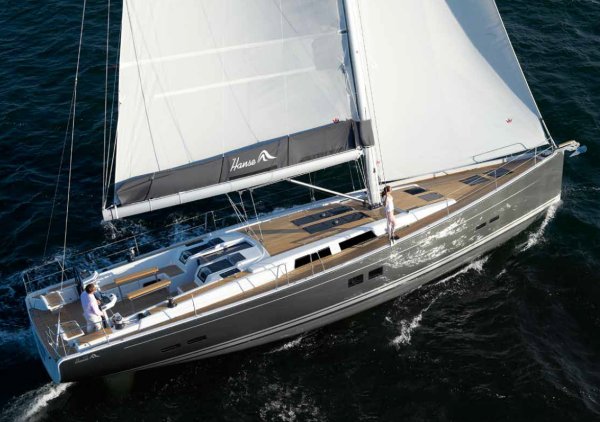
The design philosophy is centered on ease of handling for couples or small crews. All halyards and control lines are led aft to twin helm stations, the jib is self-tacking as standard, and an optional roller-furling mainsail further reduces the workload underway. A large hydraulic stern platform conceals a dinghy garage sized for a Williams jet tender, a feature uncommon at this price point. Hanse reportedly received around 100 orders early in the model's life, reflecting strong market reception.
Design and Construction
The hull uses sandwich construction with a balsa core and vinylester resin, a combination chosen for its balance of stiffness and weight reduction. The fin keel is a T-shaped profile fitted with a ballast bulb, contributing to a ballast ratio of approximately 30 percent. A single semi-balanced spade rudder provides steering. The nearly plumb bow and stern maximize waterline length relative to overall length, supporting efficient hull speeds on passage.
High topsides — 110 cm at the stern and 150 cm at the bow — generate the interior volume that defines the 575's appeal, though the same freeboard creates some practical challenges for boarding and deck access. The hull carries large square hull ports that admit good natural light to the cabins below. No chines are used, preserving a traditional hull form. Mast height reaches approximately 83 feet, and the keel-stepped rig is built around double spreaders.
Under Sail
On the water the Hanse 575 performs well for her size and displacement. During sea trials conducted by Yachting World, she held 8 to 8.5 knots upwind at 30–35 degrees apparent wind angle, and regularly exceeded 10 knots on a broad reach, touching 11 knots in favorable conditions. Blue Water Sailing noted a cruising speed of 7.5 knots at 2,200 rpm under power, with a motoring range of roughly 845 miles at conservative throttle settings. For a boat of this beam and displacement, testers reported she was quite close-winded for a cruising design.
Helm feel through the optional carbon twin wheels was described as direct, with good feedback through the rudder. The self-tacking jib and mainsheet configuration allow one or two people to handle the boat in most conditions. The boat stood up well to wind, with her displacement and ballast providing adequate stiffness. The Volvo Penta D3 shaft-drive installation delivers reliable propulsion, though engine noise insulation on early examples was noted as insufficient by some reviewers.
Specifications
| LOA | 56' 3" (17.15 m) |
|---|---|
| LWL | 49' 8" (15.15 m) |
| Beam | 17' 1" (5.20 m) |
| Draft (standard) | 9' 5" (2.85 m) |
| Draft (shoal) | 7' 4" (2.25 m) |
| Displacement | 42,990 lbs (19,500 kg) |
| Ballast | 13,007 lbs (5,900 kg) cast iron |
| Sail Area (upwind) | 1,738 ft² (161.5 m²) |
| Sail Area (downwind) | 3,202 ft² (297.5 m²) |
| Engine | Volvo Penta D3, 107–110 hp diesel |
| Fuel | 137–138 gal (520 L) |
| Water | 214 gal (810 L) |
| Designer | Judel/Vrolijk & Co (Germany) |
| Builder | Hanse (Germany) |
| Years Built | 2012 – discontinued |
| Rig | Sloop |
| Keel | Fin keel |
Accommodation
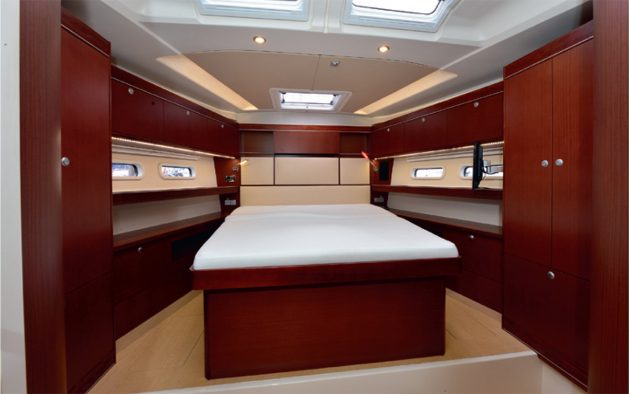
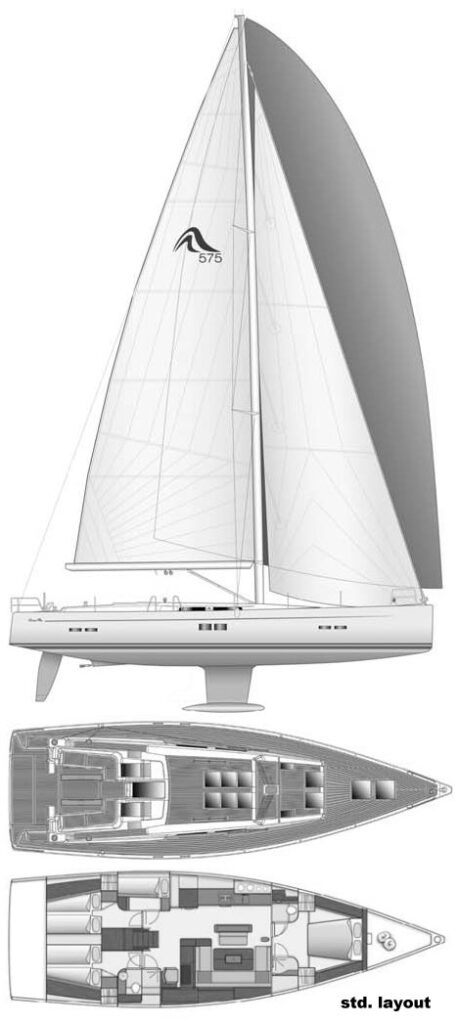
Hanse offered the 575 in up to six different interior layouts, ranging from three to six cabins with two to four heads, accommodating six to twelve berths. The most common configuration is a three-cabin, three-head arrangement with a forward master stateroom featuring a centerline island berth, twin quarter cabins aft each with an en-suite head, and a generous saloon amidships. Headroom reaches 235 cm in the aft cabins and 227 cm under the saloon hatches — exceptional for a production cruiser.
The saloon is defined by a full-length galley to port, a large dinette capable of seating eight to starboard, and double flush deck hatches overhead that flood the space with light. Custom cambered Lewmar hatches feature throughout. The boat's systems support extended passages, with 214 gallons of fresh water and 137–138 gallons of diesel. Options extend to air conditioning, a dishwasher, wine cooler, and a flatscreen television, reflecting the 575's positioning as a bluewater yacht that doubles as a floating home.
Links, References and Further Reading
Image Gallery