Catana 47
Overview
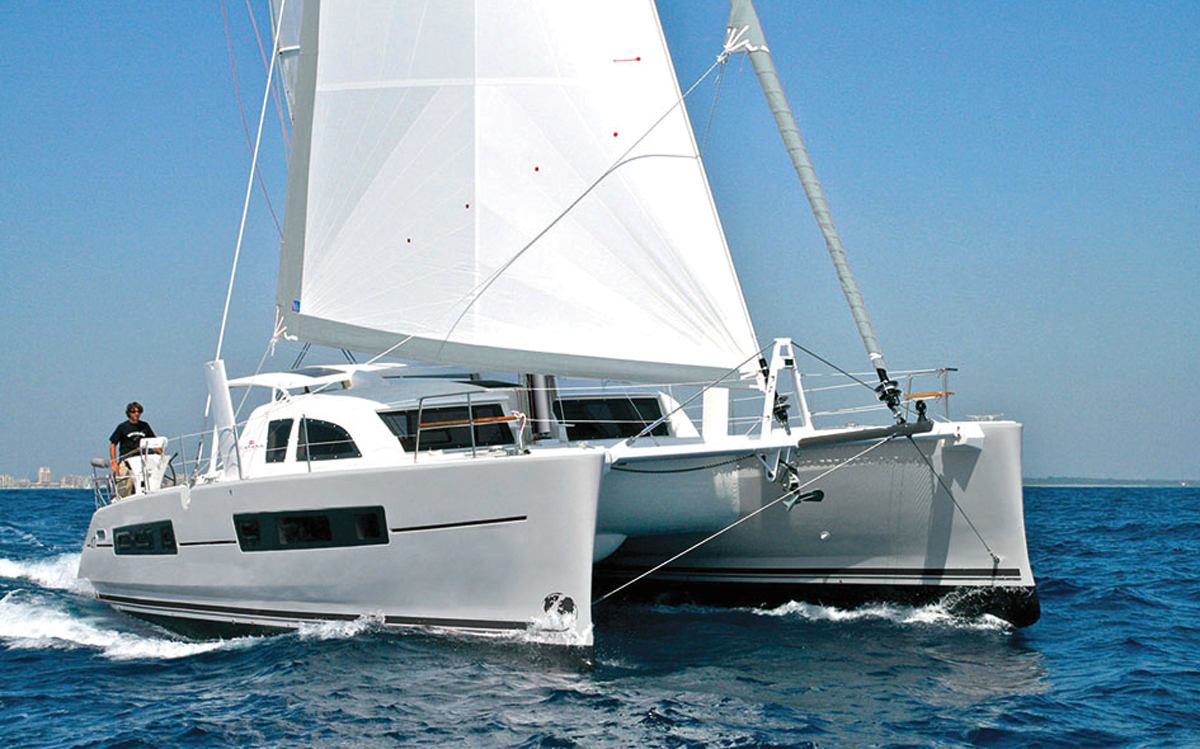
The Catana 47 is a high-performance bluewater cruising catamaran designed by Christophe Barreau and built by Catana Catamarans in Cogolin, France. Introduced in 2010 as a clean-sheet replacement for the Catana 471, the model made its US debut at the 2012 Miami Boat Show. The design is aimed squarely at the performance-minded offshore sailor: a couple or small family intent on blue-water passage-making who want meaningful boat speed without giving up offshore safety or long-range self-sufficiency.
A defining feature of every Catana is a pair of retractable daggerboards that allow the draft to swing between a shallow 3 feet 7 inches with boards fully raised and a deep 8 feet 2 inches with boards fully lowered. This range gives the 47 genuine upwind ability while still letting it tuck into shoal anchorages. Twin helm stations — one mounted on each hull — provide redundancy and good sightlines, hallmarks of the Catana philosophy.
Construction
Catana built the 47 with a strong emphasis on weight reduction and structural integrity. The hulls and deck use vacuum-infused sandwich construction with closed-cell Airex foam coring, glass, and polyester-vinylester resin. Twaron aramid fiber — an engineered material significantly stiffer and lighter than standard fiberglass — is incorporated at the bows for impact resistance, while carbon fiber is used at highly stressed structural nodes. Cabin tops and other weight-critical components above the waterline are built from infused carbon-foam sandwich to keep the center of gravity low. The revised construction program shed roughly 1,500 lb compared to the earlier generation, yielding a light displacement of approximately 24,030 lb (10,900 kg). The hull form features what Catana calls tulip-shaped bows, designed for fine entry when going to windward while providing reserve buoyancy to resist pitchpoling on fast downwind runs.
Steering is handled via a rack-and-pinion Lewmar system at each helm position, and all primary sail controls are led aft to the helms so the boat can be managed by a small crew. Electrical systems are generous: a 920 Ah house bank supports the watermaker, generator, and electric winches specified as standard.
Under Sail
The Catana 47 is a genuinely fast cruising catamaran. During sea trials reported at the time of its release, the boat reached speeds approaching 25 knots and sustained cruising speeds in the high teens. In more modest conditions — a beam reach in 12-plus knots of breeze — speeds close to 9 knots were easily achieved, and closehauled performance in the same wind was reported in the high 7-knot range, remarkable for a loaded offshore cat. The daggerboards are essential to windward performance: with them fully deployed, the 47 tracks and points in a manner closer to a racing monohull than most cruising catamarans.
The sail plan pairs a large square-topped mainsail of 926 sq ft (86 m²) with a 145-percent genoa, giving a generous upwind canvas area of roughly 1,496 sq ft (139 m²). Downwind area stretches to approximately 1,830 sq ft (170 m²). Twin 40 hp Volvo diesel engines on saildrives provide reliable auxiliary propulsion; motoring trials showed 7.4 knots at a quiet 2,200 rpm and over 9 knots at full throttle.
Specifications
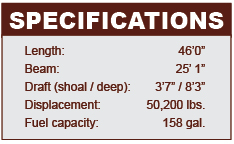
| LOA | 46' 0" (14.02 m) |
|---|---|
| LWL | 45' 6" (13.88 m) |
| Beam | 25' 1" (7.64 m) |
| Draft (boards up) | 3' 7" (1.1 m) |
| Draft (boards down) | 8' 2" (2.5 m) |
| Displacement | 24,030 lb (10,900 kg) |
| Sail Area (upwind) | 1,496 sq ft (139 m²) |
| Sail Area (downwind) | 1,830 sq ft (170 m²) |
| Mainsail | 926 sq ft (86 m²) |
| Genoa | 570 sq ft (53 m²) |
| Engine | 2 x 40 hp Volvo diesel (saildrive) |
| Fuel | 158 gal (600 L) |
| Water | 177 gal (670 L) |
| Designer | Christophe Barreau |
| Builder | Catana Catamarans, Cogolin, France |
| Year Introduced | 2010 |
| Rig | Sloop |
Accommodation
Below decks, the Catana 47 is configured primarily for a cruising couple or a family with children rather than charter groups. The standard three-cabin layout places an owner's suite in the starboard hull, featuring a full double berth, a dedicated vanity and desk, and a private head with shower. The port hull holds two guest cabins — a forward double berth and aft twin berths — served by two additional heads. Total berth count is six. Maximum headroom reaches 6 feet 6 inches to 6 feet 11 inches depending on position.
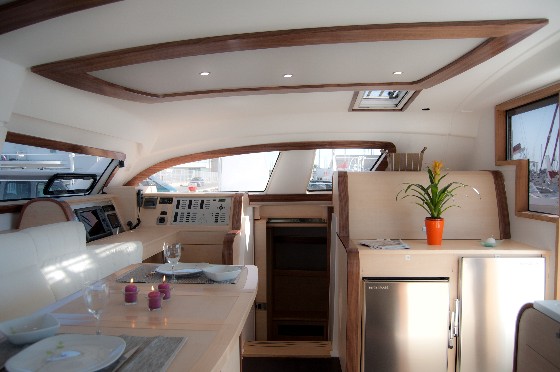
The saloon connects both hulls across a central bridgedeck and houses an L-shaped galley with a three-burner stove and dual sinks, a full navigation station with dedicated electronics space, and comfortable dining and lounging areas. Fresh-water tankage of 177 gallons (670 L) and fuel of 158 gallons (600 L) support extended offshore passages. A watermaker and generator were standard-fit options on most production boats.
Links, References and Further Reading
Image Gallery