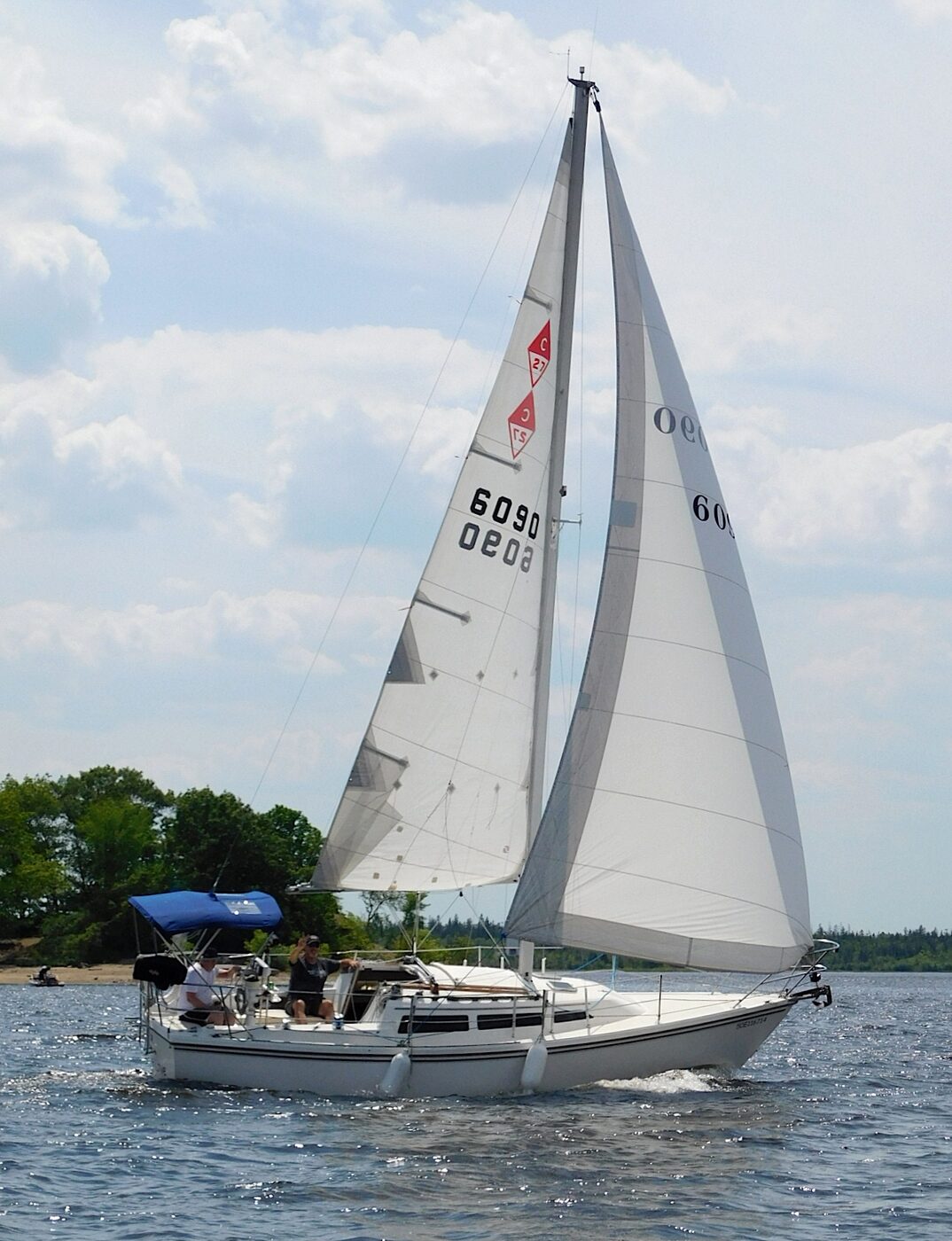
Catalina 27
Overview
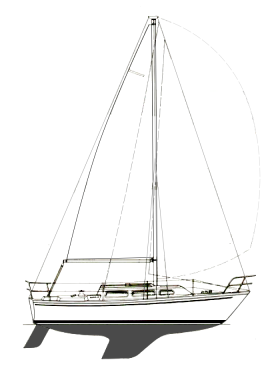
Launched in 1971, the Catalina 27 has been a popular favourite, enjoying the kind of commercial success that's led to one of the longest and largest production runs of its era spanning 22 years and 6,600 boats. From the outset she was designed to be affordable (some have even said cheap) for weekend excursions, club racing and coastal cruising - offshore work was always outside of the design scope. Yet despite this there has been at least one circumnavigation demonstrating that this vessel, with the right preparation and skills, can be an ocean passage maker. We've included this boat here more for its popularity than its inherent seaworthiness.
History
The Catalina 27 was conceived in a 1970 design partnership between Robert Finch, and the founder of Catalina Yachts, Frank Butler. Butler built an incredible number of 27s at his boat factory in Southern California using modern boatbuilding processes that are not too different to methods employed today. Initial production started in 1971. She had a incredibly spacious interior and she was affordably priced at a time when cruising sailboats had captured the public imagination. These factors helped the boat find immediate success, in fact in the first three years 1,500 boats popped off the production line - that's ten per week.
Early models were only available with outboard engines, an inboard option of an Atomic 4 engine was added in 1973, which later expanded to other engine varieties in successive years. The outboard engine option was later phased out in 1989. For shallow waters, a shoal draft winged-keel version was introduced in 1979. And popular among club racers, there was a version with a taller, more efficient, high aspect ratio rig which added 24 sq.ft. of canvas.
Production spread also to Canada and the UK. Cooper Enterprises in British Columbia, at the time one of the largest Canadian boatbuilders, produced well over a thousand boats under license for the Canadian domestic market and are a common sight around BC waterways today. While across the pond in the UK, the boat was built under license from as early as 1971 under the brand name Jaguar for UK and European markets. These were produced in Essex by Eric Birch Yachts (from 1971) and Russell Marine (from 1975) with the hulls molded by Seamaster Boats.
In 1979 a young 28 year old Patrick Childress set off in his shoal draft Catalina 27, Juggernaut, on a successful 3 year single-handed circumnavigation which included a 6400-mile, 53-day passage of the Indian Ocean.
After an unprecedented 22 years of production resulting in 6,600 boats, production finally ceased in 1991. Catalina succeeded the long lasting design with an all-new water-ballasted and trailerable weekender, the Catalina 270.
Configuration
The Catalina 27 is a fin-keeler with a raked spade rudder hanging about as far aft as possible, pushed along by a masthead sloop rig that’s tall and efficient. The hull shape is shallow and beamy which is great for initial stiffness to the wind but reduces liveable volume below the waterline. Butler made up for this by drawing deep topsides and a high cabin top all while keeping the design sleek to the eye. The result gives this 27-footer class leading interior headroom and space.
Layout and Interior
Below deck can best be described as light and spacious, this boat offers so much accommodation that many are willing to forgo her flaws. The companionway and hatch is wide which poses a water ingress hazard at sea but is responsible for her spacious feel in the cabin while at anchor. There’s technically berths for six in the standard aft-galley layout - two in the forepeak and the port side settee will really only fit kids or very short adults, while the starboard settee converts to a cozy double berth, and finally there’s a starboard seagoing quarterberth. The galley with its two burner stove is located on port below the companionway while the head is located just aft of the forepeak on starboard and is comfortably sized. Opposite the head is a locker, but note, as is typical of boats this size, locker and stowage space is in short supply.
Construction
Construction was pretty light. The hull is of solid fiberglass and much thinner than typical offshore counterparts, particularly above the waterline where small impacts that would normally lead to just a scratch may result in fractures for the Catalina 27. Early boats, as a cost cutting measure, lacked proper backing plates on deck hardware, stanchions, and rails, which lead to cracked gelcoat and in some cases fiberglass delamination. This was remedied in later boats.
Under Sail
The feel of the helm is very light and she sails responsively, or to quote the ever humorous John Vigor in 20 Small Sailboats to Take you Anywhere, "She handles like a dinghy, which is hardy surprising since that’s what she basically is - a dinghy with grandeur”. She is relatively stiff and holds her canvas well in a breeze. All this makes for a fast boat that’s easily controlled. The downside is seaworthiness. For best results Vigor recommends keeping her cruising weight down, as reduced weight will reduce stresses on the rig and hull at sea.
Note that the Catalina 27 is a beamy boat, and like others, there is a tendency for weather helm on greater angles of heel that will require either reefing the mainsail to maintain balance.
Specifications
| LOA | 26' 10" |
|---|---|
| LWL | 21' 9" |
| Beam | 8' 6" |
| Draft, Standard | 4' 0" |
| Draft, Shoal Keel | 3' 5" |
| Displacement, Standard | 6,850 lbs. |
| Displacement, Shoal Keel | 7,300 lbs. |
| Ballast, Standard | 2,700 lbs. |
| Ballast, Shoal Keel | 3,150 lbs. |
| Sail Area, Standard | 340 sq. ft. |
| Sail Area, Tall Rig | 364 sq. ft. |
| Bridge Clearance, Standard | 38'3" |
| Bridge Clearance, Tall Rig | 41' 0" |
| Headroom | 6’ 1" |
| Engine | Atomic 4 Inboard / Outboard, Various |
| Fuel | 15-20 US. Gal. |
| Water | 18 US. Gal. |
| Designer | Robert Finch / Frank Butler |
| Builder, United States | Catalina Yachts, California |
| Builder, Canada | Cooper Enterprises, British Columbia |
| Builder, United Kingdom | Eric Birch, Essex / Russell Marine, Essex |
| Year Introduced | 1971 |
| Year Ended | 1991 |
| Total Built | 6662 |
| Also Known As | Jaguar 27 (UK/Europe) |
| Rig | Sloop |
| Keel | Fin keel |
| Sleeps | 6 |
Buyers Notes
More than 6,600 Catalina 27s were made, so there’s plenty to choose from. If you’re on the hunt for a boat to sail protected coastal waters at a good price then she’s a good choice. For offshore work do your research and make sure you’ve modified your boat according to recommendations - probably the most important are enlarging the cockpit drains, reworking the companionway hatch area to help direct water into the cockpit, and uprated rigging including chainplates for the aft lower shrouds.
Some known weaknesses with this boat are listed below:
As mentioned, early boats lacked backing plates on hardware, leading to cracks in the gelcoat and in some cases delamination of the GRP.
Through-hull fittings were poorly installed and secondary bondings of attachments in some cases were poor.
Leaky chain plates have caused bulkheads to deteriorate which in turn has increased the risk of rig failures.
Fuel tank installations were poor on early inboard models.
The original spreader sockets were made of cast aluminium which tended to crack when overstressed.
Through-hull fittings in early boats were simply pipe nipples glassed into the hull and will need swapping out for proper flanged, bolt-through bronze fittings.
While heeled, some have reported seawater back flowing into the icebox via the drain. Fit a proper seacock to the through-hull.
Links, References and Further Reading
- The Catalina 27/270 Owners Association
- Twenty Small Sailboats to Take You Anywhere by John Vigor, (Ch8, p45-52) an in depth look at the Catalina 27. ISBN:978-0939837328
- Used Boat Notebook, Catalina 27, review by John Kretschmer, SAILING Magazine, Nov 2002, volume 37, no. 3
- Jaguar Owners Association for European Catalinas under the brand name Jaguar
- A biography of Forbes Cooper of Cooper Yachts who built the Canadian Catalina 27s
- Cruising World Magazine's article on Patrick Childress' two circumnavigations, first in his Catalina 27 and then in his Valiant 40 two decades later.
Similar Boats
Image Gallery