Cal 40
Overview
The Cal 40 is an American offshore racing sailboat designed by C. William Lapworth and first launched in 1963 by Jensen Marine (Cal Yachts) of Costa Mesa, California. The project brought together Lapworth's design talent, California sailor George Griffith, and yard owner Jack Jensen to create what became one of the most influential production sailboats in American racing history. Approximately 156 hulls were completed between 1963 and 1971.
The design was considered radical for its era: a flat, wide underbody, a lightweight fin keel, and a high-aspect spade rudder were all departures from the conventional offshore thinking of the day. Its displacement ran roughly 25 percent below comparable boats and its waterline length was notably longer, giving the hull an inherent speed advantage. The Cal 40 proved so dominant under the Cruising Club of America handicap rule that it is sometimes credited with hastening that rule's replacement by the IOR.
Construction
The hull is built from hand-laid fiberglass and polyester resin, making the Cal 40 among the earliest mass-produced fiberglass offshore racers. Plywood bulkheads and fiberglass interior liners complete the structure. The interior woodwork is mahogany, giving the cabin a traditional warmth despite the racing-focused layout. Original examples left the factory with gasoline Atomic 4 engines; most surviving boats have been refitted with Perkins 4-107 or 4108 diesel units driving through a V-drive transmission.
As the fleet has aged, common structural concerns include tabbing failures where bulkheads meet the hull, moisture ingress leading to rotted plywood, and rudder deterioration. Many owners have addressed these issues with reinforced tabbing, additional glassing, and upgraded chainplate attachment points.
Under Sail
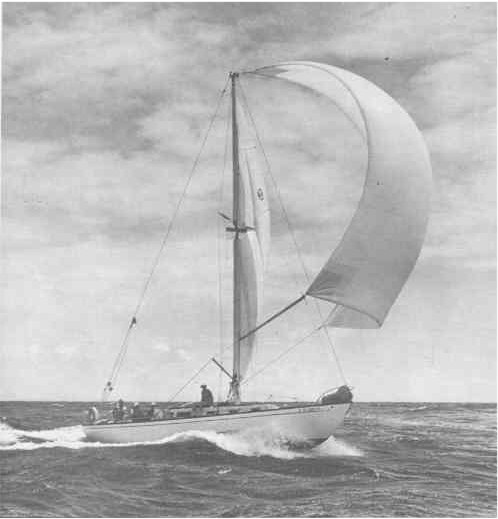
The Cal 40 carries a masthead sloop rig with a total sail area of around 700 square feet. Its flat bottom, hard bilges, and relatively low displacement give it a sail-area-to-displacement ratio that was exceptional for a production boat of the 1960s. In moderate breezes of 10 to 15 knots upwind, the boat accelerates readily and can sustain seven knots without difficulty. Its greatest reputation, however, is downwind: the flat hull sections allow it to surf wave faces in a way that was largely unprecedented among production offshore racers of its generation.
Racing results underscored this capability. The design swept the 1964 Southern Ocean Racing Conference, and a Cal 40 finished first overall in the 1966 Newport to Bermuda Race from a fleet of 167 boats. In its first full racing season the type reportedly won 67 of 70 races entered. The flat bottom does produce noticeable hobby-horsing and pounding in a steep chop, and the boat tends to load up in heavy air at the bottom of a wave run, but those trade-offs were acceptable for a design whose primary mission was speed.
Specifications
| LOA | 39' 4" (11.99 m) |
|---|---|
| LWL | 30' 4" (9.24 m) |
| Beam | 11' 0" (3.35 m) |
| Draft | 5' 7" (1.70 m) |
| Displacement | 15,000 lb (6,804 kg) |
| Ballast | 6,000 lb (2,722 kg) |
| Sail Area | 700 sq ft (65 m²) |
| Engine | Perkins 4-107 or 4108 diesel (50 hp) |
| Designer | C. William Lapworth |
| Builder | Jensen Marine (Cal Yachts) |
| Year(s) | 1963–1971 |
| Rig | Sloop |
| Keel | Fin keel |
Accommodation
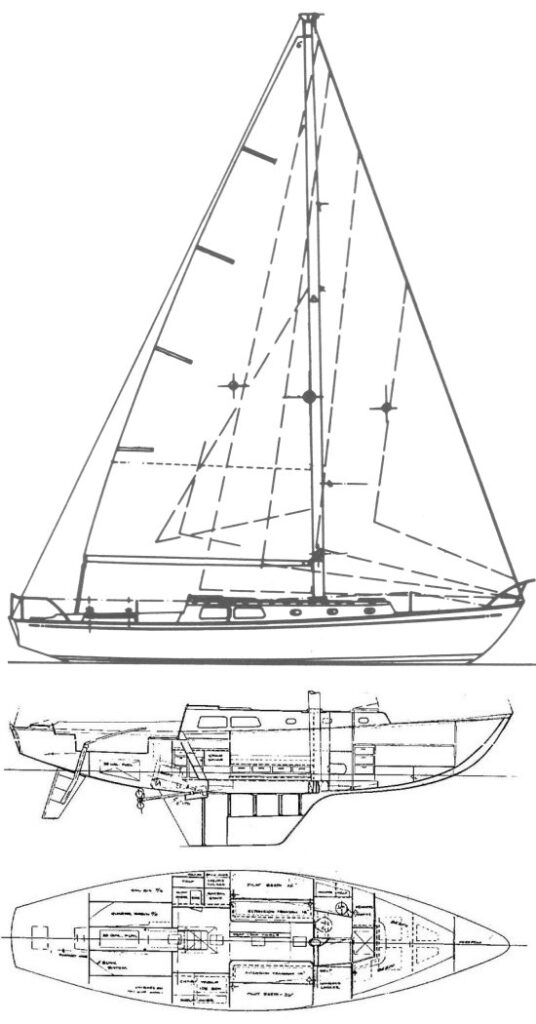
The interior was laid out to support an offshore racing crew rather than family cruising comfort. Sleeping capacity runs to eight, distributed between a V-berth in the forward cabin, two settee berths and two pilot berths in the main saloon, and two aft quarter berths. The galley sits to port and a chart table or ice-box to starboard, though the original arrangement lacked a proper sit-down navigation station by modern standards. A head is located aft of the forward cabin.
Despite its racing heritage the Cal 40 has proven entirely capable as a passagemaker. Its seaworthy hull form, manageable rig, and proven blue-water record have kept it in active offshore use for more than six decades, and well-maintained examples remain competitive in vintage racing classes today.
Links, References and Further Reading
Image Gallery