Bowman 40
Overview
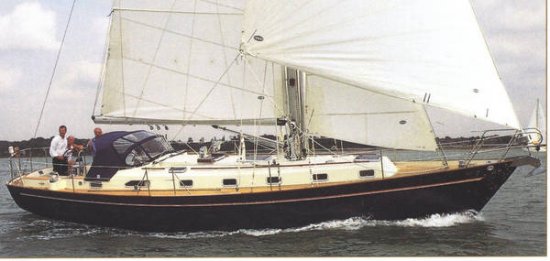
The Bowman 40 (Paine version) is a British-built bluewater cruising yacht introduced in 1987, the result of a collaboration between American designer Chuck Paine and UK builder Southern Boat Building, trading as Rival Bowman. At just under 40 feet on deck, she was conceived from the outset for serious offshore passagemaking rather than coastal racing or weekend cruising, and production continued until approximately 2002. Two distinct Bowman 40 designs exist: an earlier Laurent Giles design from the 1970s built by Emsworth Marine, and the better-known Paine design addressed here.
With a displacement-to-length ratio of around 259 and a ballast ratio of roughly 42 percent, the Bowman 40 sits firmly in the heavy-displacement cruising category. Her Cape Fear Safety Factor of approximately 1.94 and a comfort ratio above 34 reflect a hull optimised for ocean stability and a relatively easy motion in a seaway, characteristics that made her popular among couples planning extended blue-water voyages.
Design and Construction
The hull is laid up in solid fibreglass, while the deck employs a balsa or foam core sandwich to add stiffness without adding unnecessary weight above the waterline. A lead keel supplies the substantial ballast needed for the boat's high initial stability and strong self-righting characteristics. The keel itself is a moderate fin, and the rudder is carried on a skeg rather than as a freestanding spade — an arrangement that improves tracking, protects the rudder from debris and groundings, and gives the helm a firm but responsive feel.
Teak is used extensively throughout the deck and interior joinery, giving the Bowman 40 the traditional aesthetic typical of British bluewater yachts of the period. The overall build standard attracted strong praise in contemporary reviews, with Yachting Monthly noting that very few compromises in seaworthiness were made in the interest of comfort or marketing appeal.
Under Sail
The Bowman 40 is typically rigged as a masthead cutter, a configuration well-suited to offshore work where the ability to reduce and redistribute sail area quickly in deteriorating conditions is more valuable than outright light-air speed. The divided fore-triangle allows a smaller, more manageable headsail to be set on the inner forestay when conditions worsen, without the need to carry a full-sized genoa. A sail area of 743 square feet provides a sail-area-to-displacement ratio of roughly 17.8 — enough to keep the boat moving in light air while remaining manageable shorthanded in a breeze.
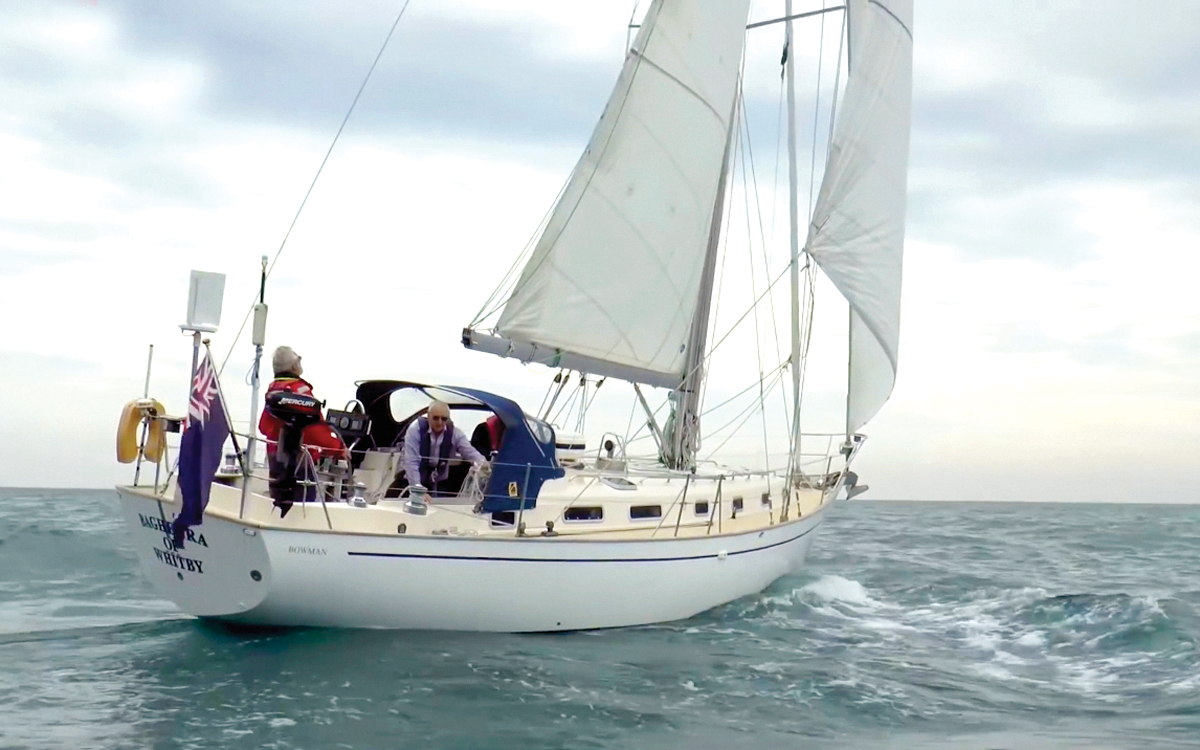
Her motion is that of a momentum boat: she takes a little wind to get up to speed but sustains that speed well in a chop where lighter designs lose way. Steering is described as light but positive, with the longish keel and skeg combination giving excellent directional stability over long watches. Hull speed is calculated at around 7.6 knots, and the 50 hp Perkins diesel pushes her comfortably at 6 to 6.5 knots under power.
Specifications
| LOA | 39' 11" (12.17 m) |
|---|---|
| LWL | 32' 0" (9.75 m) |
| Beam | 12' 7" (3.83 m) |
| Draft | 4' 11" (1.50 m) |
| Displacement | 19,000 lb (8,618 kg) |
| Ballast | 8,000 lb (3,629 kg) — lead |
| Sail Area | 743 ft² (69.0 m²) |
| Engine | 50 hp diesel (Perkins Prima M50) |
| Fuel | 70 US gal (265 L) |
| Water | 120 US gal (454 L) |
| Designer | C. W. (Chuck) Paine |
| Builder | Southern Boat Building / Rival Bowman (UK) |
| Year(s) | 1987–2002 |
| Rig | Cutter |
| Keel | Fin keel w/ skeg |
Accommodation
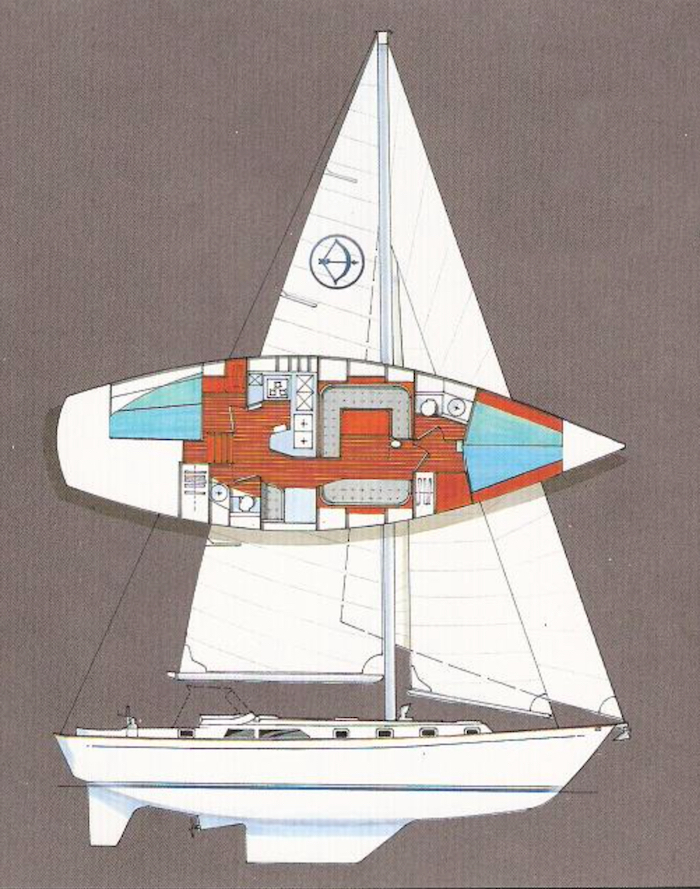
The interior is arranged for two people living aboard over extended passages, with enough flexibility to accommodate guests. A full-width saloon table can seat six for meals, flanked by settee berths that convert to sea berths. The galley is large for a 40-footer — often described as massive — and is positioned close to the companionway where the cook can brace securely while the boat is heeled. Two separate sleeping cabins provide privacy on longer voyages, and at least two heads with showers are fitted.
Tankage is generous by the standards of the era: approximately 454 litres of fresh water and 265 litres of fuel, supporting extended passages away from shore facilities. The teak joinery throughout gives the saloon a warm, traditionally crafted appearance that has aged well and remains a selling point in the used-boat market.
Links, References and Further Reading
Image Gallery